Output Formats
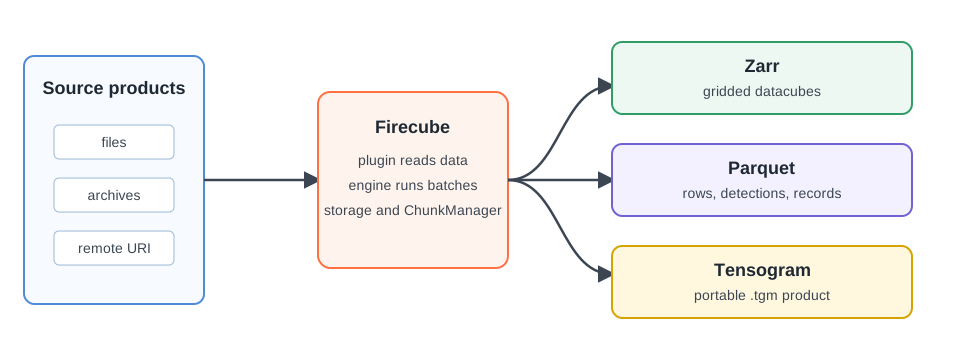
Choose the output format from the product you want to build. Firecube can write
gridded datacubes as Zarr, tabular products as Parquet, and package
finished Zarr products as single Tensogram .tgm files.
The output format is separate from storage. The same product shape can be written
to a local file:// target or an s3:// target by changing the ingest flags.
Choose By Product Shape
| Your product is | Use | Why |
|---|---|---|
| A gridded datacube with dimensions such as time, latitude, longitude, channel, or forecast step | Zarr | Readers can open subsets of a large array product without downloading everything. |
| Rows, detections, point observations, or feature records | Parquet | Each batch can write independent columnar files that downstream tools can filter efficiently. |
| A finished Zarr product that needs to move as one file | Tensogram | The product can be packaged as a .tgm file for transfer, download, or archival cold storage. |
How The Choice Affects Firecube
| Format | Plugin path | Parallel behavior |
|---|---|---|
| Zarr append | GenericZarrIngestor |
Source parsing can run in parallel; appends to one Zarr group are serialized. |
| Zarr direct region | DirectZarrIngestor |
Disjoint regions can be written directly; slot workers can write the same group in parallel when the plugin opts in. |
| Parquet | GenericParquetIngestor |
Batches write independent files, so pipeline workers can parallelize both preparation and writes. |
| Tensogram | Archive commands | Package a finished Zarr product as .tgm, then inspect, validate, or restore it back to Zarr. |
If you are building a plugin, choose the output format first, then choose the
matching plugin base class. If you are running an existing plugin, the plugin
documentation should tell you which --output-format and --write-mode to use.
Next Steps
- Zarr — choose append or direct region writes for gridded arrays
- Parquet — write tabular records
- Tensogram — package a finished product as
.tgm - Create a Plugin — scaffold a plugin after choosing the product shape
- Performance Tuning — tune chunking, sharding, compression, and batch size