Parquet
Parquet stores tabular data in a columnar format. Use it when the product is a collection of rows rather than a multidimensional array.
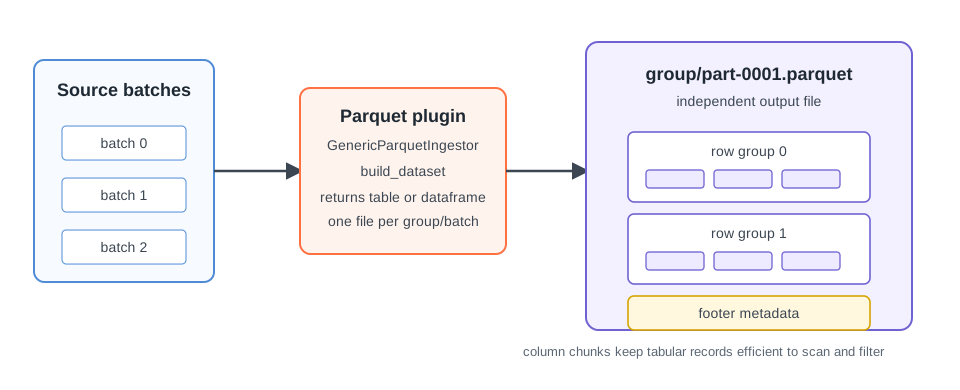
The Firecube target is a Parquet dataset root, not one output file. It contains independent part files; parts for non-default groups use their own subdirectories.
Readers should open the target as a Parquet dataset so the query engine can combine the parts and select only the required columns.
Write And Concurrency Model
Each group and batch writes its own part rather than appending to one shared file. Pipeline workers can therefore prepare data and write distinct parts concurrently. Non-default groups are separated below the dataset root so their parts do not share paths.
This differs from sequential Zarr appends, where writes to one group must pass through one writer. The tradeoff is that consumers must treat the Parquet target as a dataset of parts and keep the table schema compatible across batches.
For plugin implementation, see GenericParquetIngestor.
Next Steps
- GenericParquetIngestor — implement a Parquet plugin
- Parallelism — understand independent part-file writes
- Sentinel-3 Fire Detections — create a plugin and explore its Parquet output in a notebook