DirectZarrIngestor (Region)
DirectZarrIngestor places data at absolute indexes in declared Zarr arrays.
It does not need the shared end-of-group cursor used by dataset appends. This
makes precise indexed writes possible and provides the foundation for several
processes to write disjoint ranges of one group.
Choose this model when the plugin needs explicit control over array placement
or when constructing a complete dataset for each batch is not a good fit. The
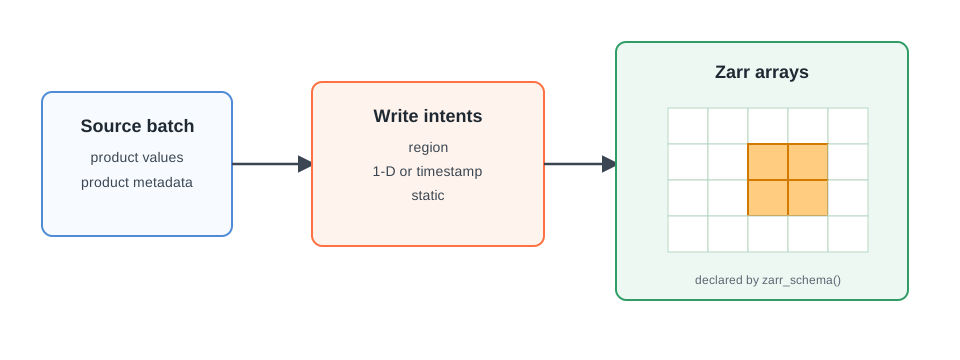
plugin emits write intents rather than returning an xarray.Dataset; Firecube
applies them through zarr-python.
How Direct Writes Work
- The plugin declares the product's time axis and its Zarr groups and arrays.
- Firecube resolves the axis into a slot index, creates missing arrays or validates the existing schema, and materializes the coordinate values.
- For each batch, the plugin returns write intents for specific arrays and indexes.
- Firecube validates and applies those intents, then records the run.
Schema And Write Intents
The schema defines each array's shape, chunks, dimensions, data type, and attributes. A write intent then describes one write, built with the factory matching its purpose:
| Factory | Purpose |
|---|---|
WriteIntent.region(...) |
Write a spatial slice at one indexed position in a rank-3 or rank-4 array. |
WriteIntent.slot(...) |
Write one complete indexed slot of an array. |
WriteIntent.coordinate(...) |
Write one indexed coordinate value. |
WriteIntent.static(...) |
Write a non-indexed array once and verify it on replay. |
The plugin owns the mapping from source data to those writes. Firecube owns schema setup and validation, storage access, write coordination, and run tracking.
Time Axes And Coordinate Ownership
The declared time axis decides what the coordinate array stores and who
writes it. Declaring one is a single entry in index_spec:
from firecube.ingestor.api import IndexSpec, TimeAxis

IndexSpec(
    name="my_product_v1",
    groups={
        "data": TimeAxis.observed(
            coordinate="timestamp",
            epoch="2024-01-01T00:00:00Z",
            cadence_s=600,
            end_date="2024-01-08T00:00:00Z",
        ),
    },
)
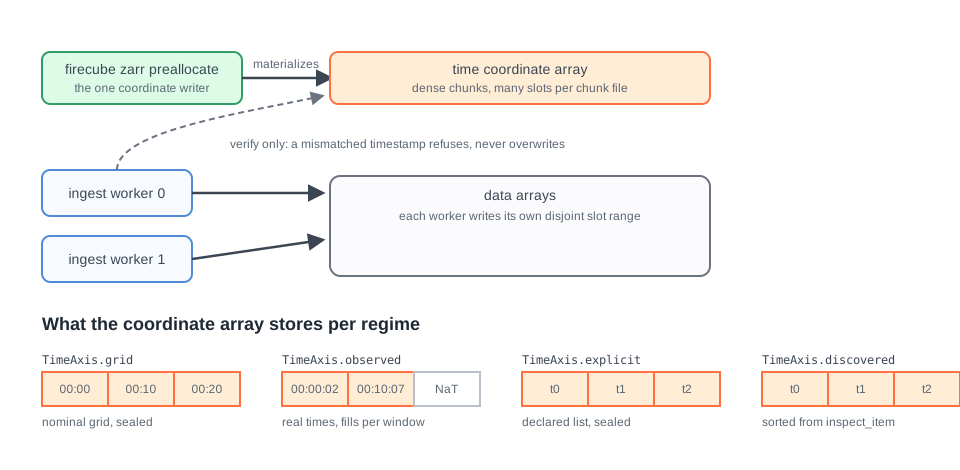
One rule underpins parallel safety: the coordinate array has a single writer, and it is never an ingestion worker. A dense coordinate keeps hundreds of slots per physical chunk, so concurrent workers writing their own timestamps would silently overwrite each other. Firecube therefore materializes coordinate values up front, and workers only verify: a write whose timestamp differs from the stored value is refused loudly, never merged.
Each TimeAxis constructor commits the product to one regime:
- Grid (
TimeAxis.grid): regular cadence and the nominal grid is the truth. Slotnstores exactlyepoch + n * cadence, so the axis is filled and sealed without reading any source data. Worker timestamps must land exactly on the grid; any deviation is treated as corruption. Claim this only when the source guarantees exact slot times. - Observed (
TimeAxis.observed): regular cadence for placement, real observation times for storage. A ten-minute sensor rarely stamps files at the slot boundary; the observation arrives at00:00:02or00:10:07. Firecube floors each timestamp onto the cadence to find its slot while the coordinate array keeps the true time. Readers get honest timestamps and the planner still gets a regular grid. This is the regime most real products need. The axis stays open-ended: windows materialize as source data arrives, and re-runs reconcile per slot instead of failing or overwriting. - Explicit (
TimeAxis.explicit): no regular cadence, but the full list of timestamps is known upfront. The declaration carries the values, so the axis is written and sealed like the grid regime. - Discovered (
TimeAxis.discovered): the timestamps live inside the source files. This declaresIrregularTimeAxis(values=AUTO), the spelling the reference and error messages use. Firecube runsinspect_itemover every item before any write, sorts the collected coordinates, and builds the axis from them. Discovery happens once and its result is handed to parallel workers by stable reference, which is whyinspect_itemmust be idempotent, order-independent, and resolvable through references that stay valid for the cube's lifetime. Duplicate or missing coordinates are refused at discovery time.
The tradeoff runs along two lines. Regular beats irregular when you can claim it: a regular axis lets Firecube plan slot ranges from the declaration alone and lets rolling products extend indefinitely, while irregular axes need the complete value set first. Within each pair, the earlier option is stricter and the later more honest: grid enforces nominal times, observed stores what the instrument measured; explicit trusts your list, discovered trusts the data. Stricter regimes fail earlier and louder, which is what you want whenever the guarantee genuinely holds.
To declare an axis, start from the routing table in the
DirectZarrIngestor guide; the exact constructor signatures are in
the Index Specification Reference.
All regimes share one failure philosophy: divergence between a stored value and an incoming one raises a schema drift error naming the slot and both values. Nothing is overwritten, and an interrupted run re-runs with the same input; matching values are no-ops and missing values are filled.
Serial Store Growth
A serial direct-write store does not need a known final indexed extent. An indexed array may begin at length zero, and Firecube grows it when an intent targets a later index. Static arrays are created at their declared shape.
A fixed, preallocated global extent is required only when the plugin opts into slot-range parallelism; see Parallel Zarr Writes for that safety model.
When To Use It
Use DirectZarrIngestor when explicit array placement is part of the product
contract, including sparse regions, indexed coordinate writes, or static arrays
that accompany indexed data, and always when you need slot-range parallel
ingestion. If the plugin can return complete, compatible xarray.Dataset
batches and serial appends suffice,
GenericZarrIngestor (Append) provides a smaller authoring
surface.
Next Steps
DirectZarrIngestorGuide — implement the axis, schema, and write-intent hooks- Parallel Zarr Writes — understand the slot-range safety model
- GenericZarrIngestor (Append) — compare the complete dataset contract
- DirectZarrIngestor (Region) Tutorial — build and run a slot-capable plugin